
Restaurant platform
MenuQR Lanka
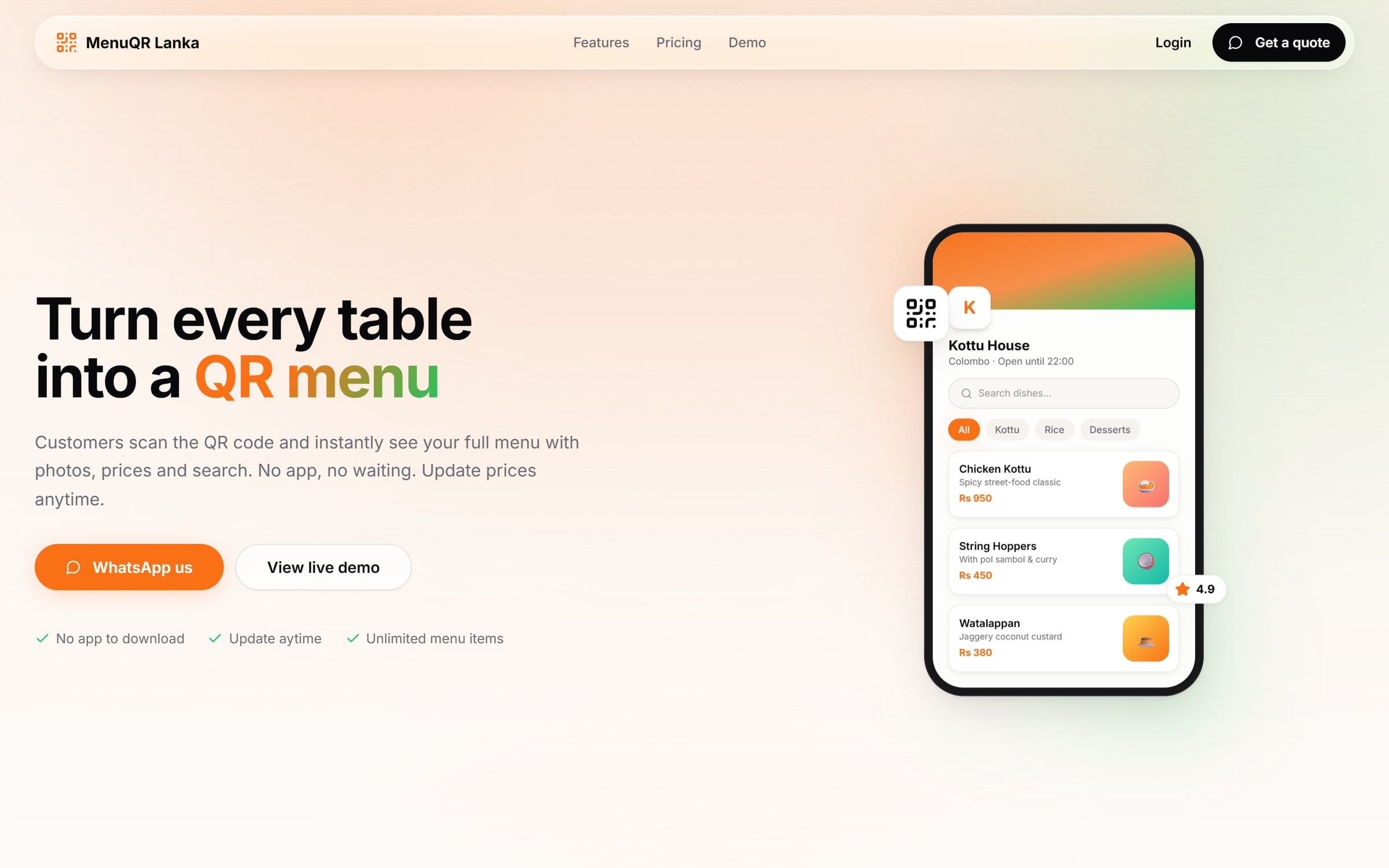
Digital menus for restaurants in Sri Lanka. Guests scan a QR code to browse the menu with photos and prices, and restaurants update it instantly.
- Client
- Trivista Labs, own product
- Capability
- Web and mobile apps
- Status
- Live
- Technology
- Next.js 15, React 19, TypeScript, Tailwind CSS, Supabase (PostgreSQL), Upstash Redis, Vercel
- Website
- menuqrlanka.com
The problem
Restaurant menus in Sri Lanka change often. Prices follow supplier costs, and dishes come and go with the season. With printed menus, every change means a reprint or a pen correction. Tourists also need to know what is in a dish, how spicy it is and whether it suits their diet, often in a language other than English.
Earlier digital menus did not fix this. PDF menus are slow to open on mobile data and hard to read on a phone. Menu apps ask guests to install something and sign in before they can see what is on offer.
What we built
MenuQR Lanka is Trivista’s own product. A guest scans the QR code on the table, and the menu opens in the phone’s browser, with no app and no sign-in.
- For guests: photos and prices, search and categories, portion options such as regular or large, add-ons, and markers for spice and diet. Menus can be read in other languages, including German, French, Russian, Chinese and Japanese.
- Ordering: each table has its own QR code. Guests build an order and send it to the kitchen or the manager on WhatsApp or Telegram, so the restaurant needs no new till or hardware.
- For owners: prices, sold-out dishes and daily specials can be changed from a phone. Owners see scans, views, popular dishes, and taps on the call, WhatsApp and directions buttons.
- The restaurant’s own look: the owner picks one brand colour, and the menu works out the rest of its palette from it, with text colours checked for contrast.
How it works
- Quick on mobile data. Menu pages are built in advance and served from a CDN. When an owner changes a dish, only that restaurant’s pages are rebuilt, so guests never see an old price.
- Each restaurant’s data kept apart. Every table in the database is protected by row-level security in PostgreSQL. Guests read with narrow, anonymous access. Changes go through database functions that check who is making them.
- Translations made once. A menu is translated on the server and the result is stored, so a guest who switches language does not wait for a translation service. If that service is down, a built-in dictionary is used.
- Light photos. Owners’ photos are resized and compressed in the browser before upload, to WebP files under 350 KB, with up to three per dish.
- Visits counted without cookies, using hashed identifiers instead.
- Rate limits use Upstash Redis, and fall back to limits kept in memory if Redis cannot be reached.
Where it stands
MenuQR Lanka is live at menuqrlanka.com and in use at restaurants in Sri Lanka. The site has a demo menu for anyone to try.